Long-Term or Short-Term Rental in Nice: Which Should You Choose?
Returns, flexibility, management, taxation, risk: the complete comparison to choose between long-term letting and holiday rental in Nice.
You own an apartment in Nice and are hesitating between letting it year-round (long-term rental) or short-term, Airbnb-style (holiday rental)? The answer comes down to three things: your return objective, the time you are willing to spend, and your risk tolerance. Here is a clear, criterion-by-criterion comparison to decide with full knowledge of the facts.
Long-term rental: security and simplicity
A long-term rental means letting your property, furnished or unfurnished, to a single tenant — usually for a year or more under a standard or furnished lease.
Its strengths: stable, predictable income, light management (one tenant, little turnover), and no tourism-related regulatory constraints. In exchange, the monthly rent is capped by the local rental market, returns are more modest, and getting your property back (to sell it or live in it) means observing notice periods.
It is the peace-of-mind option — ideal if you want regular income without any involvement.
Holiday rental: returns and flexibility
A holiday (short-term) rental means letting your property by the night or the week to a succession of travellers.
In a market as sought-after as Nice and the French Riviera, it can generate significantly higher income than a standard lease, provided occupancy and pricing are optimised. It also offers precious flexibility: you can block dates and enjoy the property yourself.
The trade-offs: intensive management (listings, check-ins, cleaning between every stay, 7/7 assistance), more variable income (seasonality), and above all strict regulations to comply with (see below). This is where a concierge service changes everything: it absorbs the entire management workload and professionalises the operation.
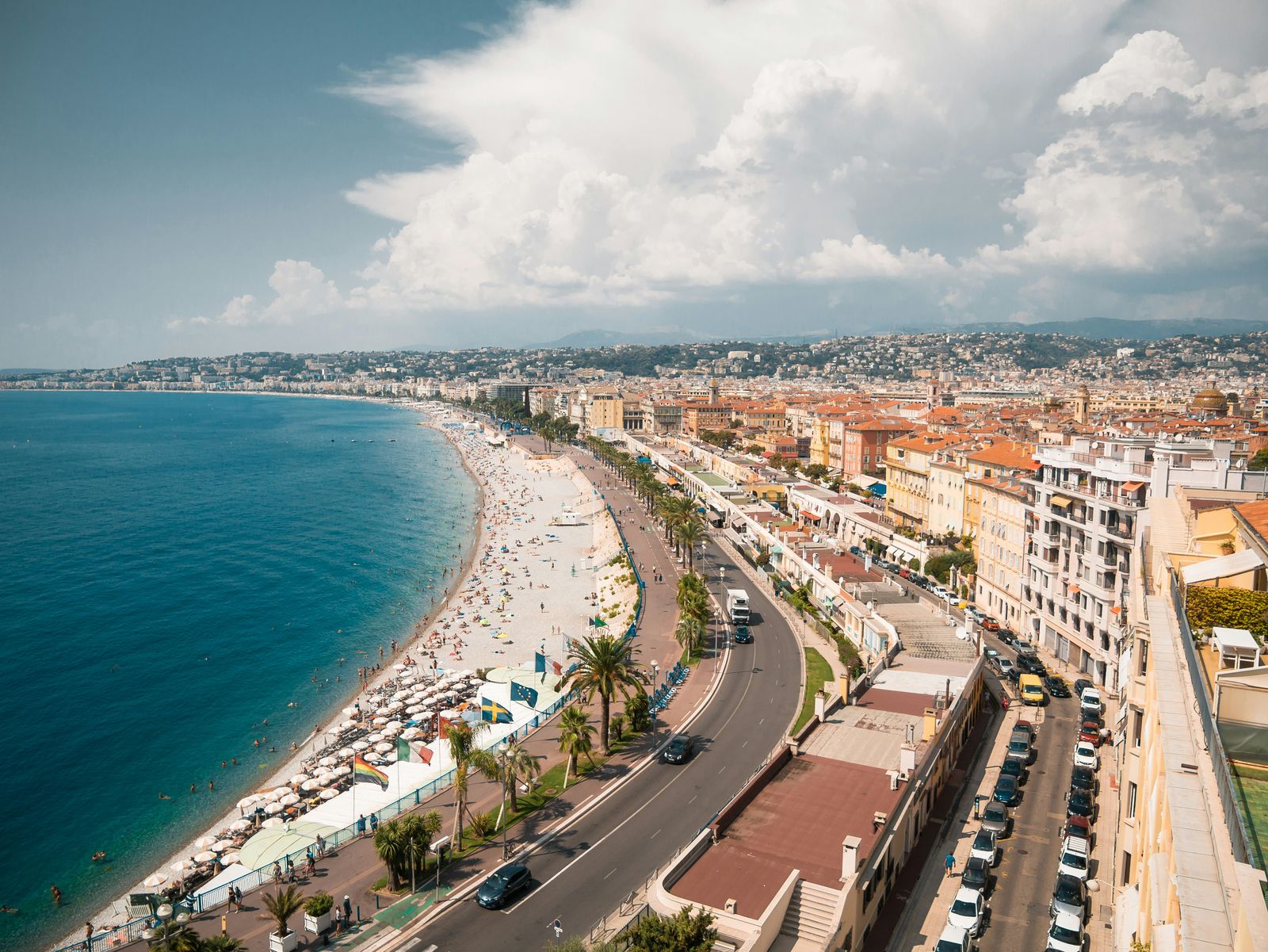
Nice's seafront, a rental market in demand all year round. Photo: Danilo Pantalena — Unsplash.
The comparison, criterion by criterion
- Returns: clear advantage to short-term on the Riviera when well managed — often higher than long-term for the same property (to be assessed case by case).
- Income stability: advantage long-term (fixed rent vs seasonality).
- Management workload: long-term is lighter; short-term is time-consuming… unless delegated to a concierge service.
- Flexibility of use: advantage short-term (you get your property back whenever you want).
- Regulations: long-term carries no tourism constraints; short-term requires registration and local rules.
- Property upkeep: short-term involves regular cleaning and inspection — which often keeps the home in better condition.
What about regulations in Nice?
This is a decisive point. Nice strongly regulates short-term rentals: a mandatory registration number on listings, collection of the tourist tax, and specific rules depending on whether the property is your main residence (capped number of rental nights) or a secondary residence (change-of-use authorisation in certain high-pressure zones). These rules change regularly: always check the current position with the City of Nice, or get professional guidance. For the full breakdown (90-night cap, 2026 permit quotas, registration), read our guide to the Airbnb rules in Nice for 2026.
Long-term rentals escape these tourism constraints entirely — a simplicity argument worth weighing.
So, which should you choose?
- You want regular income with zero involvement and no regulatory constraints → long-term.
- You are aiming for maximum returns, want to keep the use of your property, and are ready to delegate the management → short-term with a concierge service.
Many Nice owners choose short-term precisely because a concierge service removes its main drawback (the management) while securing compliance. At Be My Guest — short-term rental investors for over 7 years — we manage your property end to end and also offer direct bookings (no platform fees). Discover our owner services, or browse the properties we manage.
To go further, read our guide to choosing an Airbnb concierge service in Nice.
Official sources
To check the latest position:
- Métropole Nice Côte d'Azur — letting a furnished tourist rental (local short-term rental rules)
- Law no. 2024-1039 of 19 November 2024, the "Le Meur law" (national framework, taxation)
- Service-public.fr — letting a furnished tourist rental (declaration, host obligations)
Frequently asked questions
Does short-term rental earn more than long-term in Nice?
Usually yes, in such a touristic market, provided occupancy and pricing are optimised. The actual gap depends on the property, the neighbourhood and the quality of management; short-term income is also more variable.
Which option requires the least management?
Long-term rental (one tenant, little turnover). Short-term is more demanding, but that workload can be fully delegated to a concierge service.
Can I switch from long-term to short-term?
Yes, subject to local regulations (registration and, in some cases, change-of-use authorisation). Check your situation before switching.
Do I need a registration number for a holiday rental in Nice?
Yes: any short-term furnished rental must display a registration number on its listing, and tourist tax must be collected.
Does a concierge service help with both options?
A concierge service is mainly relevant for short-term rentals (management, guest welcome, compliance). For long-term lets, the management burden is much smaller.