Airbnb Rules in Nice 2026: The Complete Owner's Guide
New rules since 1 September 2026, 5-year permits, quotas, the 90-night cap, registration numbers: short-term rental regulations in Nice, clearly explained.
Airbnb rules in Nice changed again on 1 September 2026: a new change-of-use regulation now applies, with temporary permits extended to 5 years (only one per tax household) and quotas of 691 permits in four districts, open for applications online from 1 September to 31 December 2026. For primary residences, the City has applied a 90-night annual cap since 1 January 2026. Nice remains one of the most tightly regulated cities in France for short-term rentals — yet letting there is still entirely possible, and profitable, as long as you play by the rules. Here is the complete, up-to-date guide.
Updated 25 September 2026: new change-of-use regulation (decision of 22 June 2026) in force since 1 September 2026. Rules change regularly: the information below is given for guidance only; always check the official sources at the end of this article.
What has changed in Nice's short-term rental rules in 2026?
It has been an eventful year. A first regulation, adopted on 5 December 2025, introduced quotas and a 3-year permit; the Nice administrative court partially annulled it on 29 January 2026 over how the quotas were calculated, and applications in quota districts were suspended until 31 August. The Métropole then adopted a new regulation (Metropolitan Council decision no. 2.1 of 22 June 2026), applied since 1 September 2026. Here is where things stand today:
| Rule | What applies since 1 September 2026 |
|---|---|
| Primary residence | No change-of-use permit needed; 90-night annual cap set by the City (see below) |
| Second home (individual owner) | Temporary permit for 5 years maximum, only one per tax household, non-renewable |
| Beyond that (2nd property, after 5 years, commercial company) | Compensation or the mixed rental scheme |
| Quotas (Vieux-Nice, Riquier – Port – Mont Boron, City Centre, West) | 691 permits for 2026, online applications from 1 September to 31 December 2026 |
| Outside quotas | Applications all year; renewals, mixed rental and compensation never count towards quotas |
| All holiday lets | 13-character registration number, tourist tax declaration, energy rating (DPE) A to E for a change of use |
Source: Métropole Nice Côte d'Azur, change-of-use regulation (decision of 22 June 2026), September 2026.
In practice, your obligations depend on one simple question: are you letting your primary residence or a second home?
How many nights can you rent out your primary residence in Nice?
90 nights a year, under the city council decision of 23 May 2025, applicable since 1 January 2026: Nice used the option granted by the Le Meur law to lower the national 120-day ceiling. Platforms (Airbnb, Booking.com and others) automatically block your listing's calendar once the cap is reached, and exceeding it can lead to a civil fine of up to €15,000.
One nuance is worth flagging: since September 2026, the Métropole's change-of-use pages state that the permit exemption for a primary residence applies as long as letting does not exceed 120 days a year — the rule under the French Construction Code. The two texts coexist, and to our knowledge no repeal of the 90-night cap has been published. Our advice as investors: plan your project around 90 nights and, if in doubt, ask the City's change-of-use department for written confirmation.
Key point: a primary residence (the home you live in at least 8 months a year) does not require a change-of-use permit. You do, however, need a registration number and must collect tourist tax, like every host. If you let your house while you are away in summer, the 60 or so nights of July and August sit comfortably below the cap: see renting out your house while on holiday.
Second homes: a 5-year permit, one per household
To let a second home as a furnished holiday rental in Nice, you need a temporary change-of-use permit from the very first night. Since 1 September 2026, it is:
- valid for 5 years maximum, non-renewable, cannot be split over time, assigned or transferred to another property;
- limited to one permit per owner and per tax household;
- subject to a decent home, an energy rating (DPE) between A and E, and a sworn statement that the building's co-ownership rules allow holiday letting.
Commercial companies (SARL, SAS, EURL…) must provide compensation from their very first property. Permits already granted remain valid: 3-year permits filed between 1 January and 31 August 2026 can receive one 2-year renewal, requested within the two months before they expire.
Beyond those 5 years, or for a second property, two routes remain. Compensation: converting an equivalent surface currently in another use into housing, or buying compensation rights (titres de commercialité) — the permit then becomes permanent and attached to the property. Or the mixed rental scheme: letting to a student during the academic year and to holidaymakers for three summer months, with no compensation and no limit on the number of permits. We cover both options in our guide to the change-of-use permit in Nice and our article on Nice's mixed rental scheme.
Our view as investors: these constraints reshape the market rather than close it. Fewer holiday lets in the most pressured districts also means demand shifting towards compliant properties — and solid occupancy for those who operate properly. We weigh this trade-off in our comparison of long-term vs short-term rental in Nice.
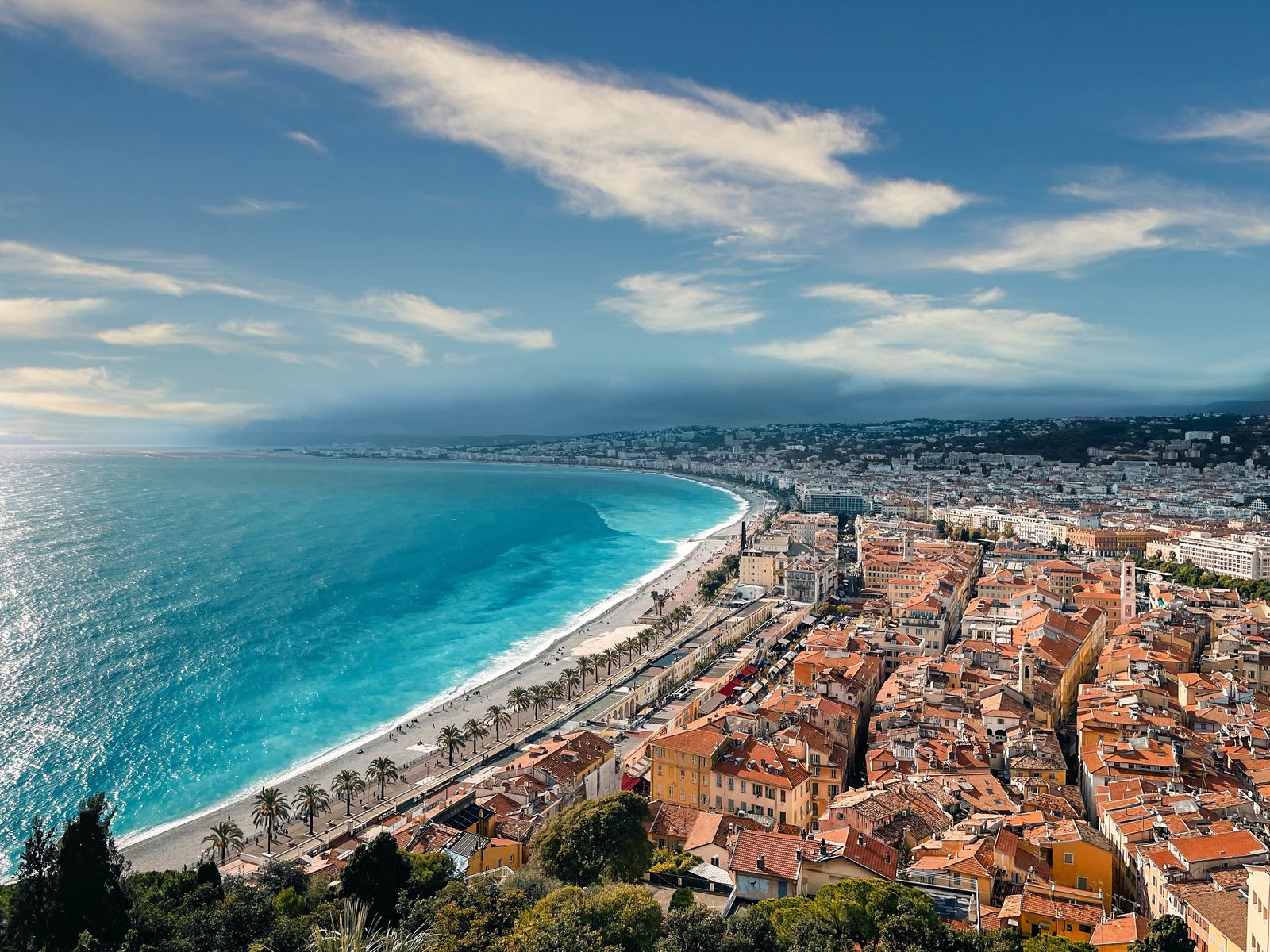
Vieux Nice and the city centre are among the four quota districts. Photo: Constantin — Unsplash.
2026 quotas: 691 permits, applications until 31 December
In the four most touristic districts — Vieux-Nice, Riquier – Port – Mont Boron, City Centre and West — new change-of-use applications are capped at 691 permits in total for 2026. Applications are filed online only, on the City's portal (changementdusage.fr/nice, where you can test your address), and only from 1 September to 31 December 2026.
The rules are strict:
- complete files are processed in order of arrival, timestamped by the platform; incomplete files are rejected;
- one file, for one property, per owner and per application window;
- in quota districts, first permits are reserved for individuals (and assimilated legal entities);
- processing takes 4 months; no reply from the authorities means refusal, and there is no waiting list.
Renewals, the mixed rental scheme, compensation files and serviced residences are exempt from the quotas and can be filed all year. Outside the four districts, applications can also be filed at any time. If your property is in a quota district, now is the time to act: a complete file submitted early stands every chance; a rushed one in December far less.
How do you get a registration number in Nice?
The 13-character registration number is mandatory for publishing any holiday rental listing in Nice, whether primary residence or second home, rated or not. It is generated when you register on the Métropole Nice Côte d'Azur tourist tax portal — and, for a second home, after the change-of-use permit has been granted (the two numbers are separate).
The Le Meur law plans a single national registration portal; its roll-out, first announced for May 2026, has been delayed. In the meantime, the Métropole procedure still applies. Penalties, however, have been raised: up to €10,000 for failing to register and €20,000 for a false declaration or using a fake number. Step by step: our guide to the Airbnb registration number in Nice.
Tourist tax and taxation: what applies in 2026
Declaring your property to the Métropole's tourist tax office is compulsory for every holiday rental, rated or not. For unrated properties, the tax is proportional to the nightly rate (around 5% excluding VAT per person per night, capped); rated properties benefit from a flat rate that is often more favourable (see our guide to the tourist tax in Nice). The major platforms usually collect the tax for you, but declaring your nights on the portal — even at €0 — remains your responsibility.
On income tax, the Le Meur law reshuffled the micro-BIC regime: the allowance for unrated holiday lets fell to 30% with a €15,000 revenue ceiling, against 50% up to €77,700 for rated properties. Getting your property officially rated has become a first-rate tax lever — see our guides to the furnished tourist accommodation rating in Nice and short-term rental taxes in Nice in 2026.
How do you stay compliant without giving up your weekends?
Let us be direct: Nice's regulations have become a profession in their own right. Between address eligibility checks, the quota application window, the DPE, the registration number, tourist tax, the mixed rental calendar and night caps, improvisation is expensive — up to €20,000 in registration fines, and far more without a change-of-use permit.
That is exactly why at Be My Guest, regulatory compliance is included end to end in our management service: we prepare and track every file (registration, change of use, mixed rental, tourist tax) for each property we manage in Nice and along the Côte d'Azur. As short-term rental investors ourselves for over 7 years, we apply to your property the same standards we demand for our own: a profitable operation, and an impeccable one. To understand everything delegated management covers, read our guide to Airbnb property management in Nice.
Wondering what the new regulation means for your property? Let's talk: free valuation and compliance review.
Official sources
- Métropole Nice Côte d'Azur — Furnished tourist rentals (new regulation of 22 June 2026, 2026 quotas, compensation, primary residences — in French)
- Métropole Nice Côte d'Azur — Change-of-use FAQ (5-year permit, renewal of existing permits, quota rules — in French)
- Public notice — map of districts and 2026 quotas (districts concerned and application period — in French)
- City of Nice change-of-use portal (test your address and apply online)
- Law no. 2024-1039 of 19 November 2024, the "Le Meur law" (local caps, energy ratings, penalties)
- Métropole NCA tourist tax portal (declaration, registration number, host account)
Frequently asked questions
How many nights can I rent out my primary residence in Nice in 2026?
90 nights a year, under the city council decision of 23 May 2025 applied since 1 January 2026, compared with 120 days nationally. Since September 2026, some Métropole pages state that the change-of-use exemption applies up to 120 days: both rules coexist, and we recommend staying within 90 nights and getting written confirmation from the City if in doubt. Platforms block the calendar once the limit is reached, and exceeding it can lead to a civil fine of up to €15,000.
What changed in Nice on 1 September 2026?
The new change-of-use regulation (Metropolitan Council decision of 22 June 2026) has applied since 1 September 2026. The temporary permit for letting a second home now lasts up to 5 years, non-renewable, with only one permit per tax household. Quotas are set at 691 permits for 2026 in four districts, with online applications only, from 1 September to 31 December 2026. Beyond one permit, owners must provide compensation or use the mixed rental scheme.
Do I need a permit to rent out a second home on Airbnb in Nice?
Yes, from the very first night. You need a temporary change-of-use permit from the City of Nice: one per owner and per tax household, valid for up to 5 years, non-renewable and non-transferable, with an energy rating between A and E. In Vieux-Nice, Riquier – Port – Mont Boron, the City Centre and West Nice, applications are also subject to a quota of 691 permits for 2026. Commercial companies must provide compensation from their first property.
Can I still apply in the quota districts?
Yes, until 31 December 2026. Applications are filed online only on the City's portal and processed in order of arrival if complete, within the 691-permit limit for the four districts. Only one file per owner per window is accepted, processing takes four months and silence means refusal. Renewals, the mixed rental scheme and compensation files are not subject to quotas and remain open all year.
What is the 13-character registration number?
It is the unique identifier every holiday-let host in Nice must display on their listings (Airbnb, Booking.com, direct booking sites), for primary residences and second homes alike. It is generated free of charge on the Métropole Nice Côte d'Azur tourist tax portal and is separate from the change-of-use permit number. The national portal planned by the Le Meur law has been delayed; until it opens, the Métropole procedure applies. Letting without a number can lead to a fine of up to €10,000.
Can a property management company handle these formalities for me?
Yes. A serious property manager handles compliance end to end: address eligibility checks, change-of-use or mixed rental files, registration number, tourist tax declarations and payments, and monitoring of new local decisions. The owner remains the official applicant for the change of use but no longer has to manage the calendar. At Be My Guest, this support is included in our all-inclusive package from 20% of revenue. Learn more about our Airbnb property management in Nice.